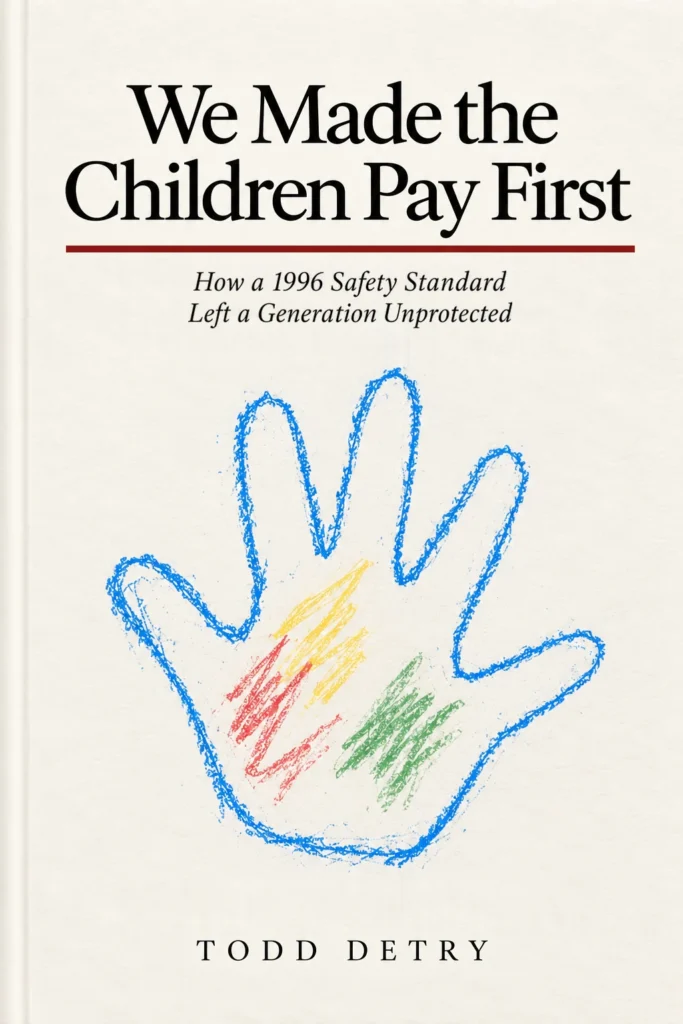
We Made the Children Pay First
I just figured somebody had checked.
I was wrong.
In 1996 we didn’t have Wi‑Fi or smartphones. And we certainly didn’t have Chromebooks in our classrooms. This is the story of a family, three generations strong, who grew up in this ever-changing world. They trusted those in power to examine all this tech and make sure the devices were safe for our kids to use. This is the story of how that rule ended up in your kid’s pocket anyway. And of one mom who goes looking, and finds more than she bargained for.
WHAT THIS BOOK IS ABOUT
What happens to a child who carries a cell phone in their pocket, every day, for eighteen years?
A cell phone is “legal” because it passed a test. That test measures one thing: how much heat a body soaks up. The test was built around a grown man. The head of a US Army serviceman to be precise. The phone was measured with the gap between the phone and your body. But in not the way any of us actually use our phone. No child’s head was ever part of any test. Just an adult male Nothing about children. Ever. And so the children became the experiment. And 30 years later, they are still the experiment.
The government tested popular phones in a pocket, the way you and I carry them. They were over the federal limit.
The FCC’s own lab ran that test in 2019 and left the results out of its public report. A records request brought them out four years later.
Even the agencies in charge admit that these long-term questions have never been properly studied.
They told us it was safe. What they meant was untested.
WHERE THE BOOK OPENS
July. An envelope from the school.
Through the kitchen window Sarah could see Mia in the yard, chasing a butterfly across the grass.
Oh, good. The supply list. Now I’ll know what to buy.
Sarah read it once. Then she read it again, slower.
Her head sank into her hands.
Now what am I supposed to do?
Sarah already knew what the rule said. She had spent six years finding out.
THE DOCUMENTED RECORD
Thirty years, in the government’s own paperwork
There were no villains. There was no conspiracy. A rule was written for a world that no longer exists. A fedral agency was told to look at the ruling again, by its own auditor and then by a federal court. They never did.
READ CHAPTER 1 · FREE
The Year She Was Born
Mark and Diane bring newborn Sarah home.
The wireless world comes home with them.
Diane sat in the back seat next to her daughter. The new car seat made her look so small. The packet the hospital had sent home with them sat at Diane’s feet, and she wondered when she would ever find the time to go through all of it. She was in awe of how eight pounds could rearrange their whole life overnight.
They rode the whole way home in silence. Diane sat with her head back against the seat, one hand resting light on the baby’s chest, feeling each small breath lift it. She was wrung out the way you only are after bringing your baby into the world, too spent for words, and not needing any.
Mark couldn’t have put it into words either, if he’d tried: how this new person, all of two days old, who could not so much as hold up her own head, had already taken complete command of his entire life. He wasn’t sure he had ever been so afraid, or so unsure of anything.
Mark drove home ten miles under the speed limit, both hands on the wheel. The whole of his life was riding in the back seat, and he drove like it.
He ran the checklist one more time, the way he had all week. Was the car seat in right. The pacifiers, were they safe? Were the diapers the right ones. The whole list, and it grew by the day.
There was one thing that never made it onto the list.
REALLY COOL
TODD PHOTO
GOES HERE
WHY ME
I’ve been selling this cool tech stuff all my life.
I grew up in Northern Wisconsin. My folks owned a small resort on a huge lake. My childhood was full of swimming, boats, and long summer days. It was a Norman Rockwell kind of upbringing. I was too young to realized how good I had it.
My wife and I met on that lake when we were teenagers. Summer love. We married years later, and we still go back to that lake every year for fishing.
After high school graduation, I enlisted in the United States Army. The Army trained me as an avionics technician. I worked on the flight line, fixing the communications equipment on aircraft and helicopters. That was my introduction to the world of electronics. When I got out of the Army, I went to work in automotive electronics, back when gas was cheap and muscle cars were king. I spent twenty years building bump systems, installing DVD players, cruise controls and radar detectors. Friday nights were cruising the streets and racing from stop light to stop light. Again, I was too young to realize how good we all had it.
In the mid-’90s, I got into computers and every other cool tech thing that came my way. For the last fifteen years my business partner and I have run a successful web design company. It’s been a blast. Recently, we started a software development business. Got to keep up with the changing world.
Even though I have some gray hair (OK, a lot of gray hair), I’d like to believe I’m still pretty hip to everything that’s going on. Through the years, I brought all of this stuff home to the people I loved. Phones and laptops and wireless routers. All of it. I never gave it a second thought. I just figured somebody had checked that all of it was safe. I was wrong.
That’s why I wrote this book.
COMING SPRING 2027
Email me when the book is available.
One email when the book is released. That’s it.
Signed copies direct from Todd · Print, e-book and audio through major booksellers
We Made the Children Pay First
How a 1996 Safety Standard Left a Generation Unprotected
© 2026 Todd Detry. All rights reserved.